Wondering Why I Use the Word “Movement” More Than “Exercise”?
Wondering Why I Use the Word “Movement” More Than “Exercise”?
It’s not an accident and it’s not me being precious about language for the sake of it. There’s a reason I tend to use the word “movement” rather than “exercise” and if you’ve lived with ME/CFS or Long Covid for any length of time, you may already have a pretty good idea why.
Still, I think it’s worth talking about because words carry associations with them. When illness has completely changed what your body can manage, some of those associations can be difficult ones.
Exercise Comes With Baggage
Say the word “exercise” and what comes to mind? Cardio. HIIT. Pushing through the last rep. “No pain, no gain.” Turning up even when you don’t feel like it because that’s what discipline looks like. For plenty of people, that might be a perfectly reasonable way to think about exercise.
I certainly didn't grow up avoiding movement. I danced from a young age and played lots of sport growing up. As a young adult, I loved Latin American and Ballroom dancing too. Being active and moving my body had always been a normal part of my life and, importantly, something I genuinely enjoyed.
Although, looking back now, the story isn't quite as straightforward as that. Long before Glandular Fever and eventually developing ME/CFS, there were occasions when my body seemed to react badly to particular types of exercise. I remember aerobics classes, for example, leaving me feeling disproportionately unwell or symptomatic rather than simply tired from exercising. At the time, I didn't understand why. I certainly wasn't thinking about energy envelopes, PEM or how my body responded to different types and intensities of activity. I can't know now exactly what those experiences meant or whether they were connected to what happened later, but with everything I understand about my body now, they are experiences I look back on rather differently.
Then Glandular Fever, and subsequently ME/CFS, changed my relationship with movement much more significantly. For a body managing ME/CFS, pushing through can come with consequences. When you experience post-exertional malaise (PEM), the payback isn’t simply sore muscles or DOMS the following day. It can mean a significant increase in symptoms which lasts for days, weeks or sometimes longer after something that may have looked, from the outside, like “just a bit of exercise”.
That can be incredibly difficult to get your head around when movement has previously been such a natural part of your life. Something you enjoyed, and something you'd always been told was good for you, suddenly becomes something you have to approach very differently. For me, learning that was a process in itself.
That’s one of the problems I have with the word “exercise”. The other runs a little deeper.
The Shadow of GET
If you’ve had ME/CFS for a while, you may well have come across Graded Exercise Therapy (GET). For years, GET was recommended as a treatment for ME/CFS and was included in previous NICE guidance. The approach involved gradually increasing activity or exercise over time.
Many people with ME/CFS reported becoming worse while following this approach and the NICE guideline published in 2021 no longer recommends programmes which use fixed incremental increases in physical activity or exercise as a treatment for ME/CFS. That history matters.
For some people, the word “exercise” carries experiences of being encouraged to keep increasing activity, push through symptoms or ignore what their own body was telling them. So hearing “have you tried exercising a bit more?” may not land as the harmless suggestion someone intends it to be. It can be frustrating too, particularly when you've already spent a considerable amount of time learning, often through difficult experience, what happens when you ask your body for more than it currently has to give.
Exercise can, of course, be helpful and appropriate in all sorts of circumstances and for many health conditions. But it isn’t automatically the right recommendation for someone with ME/CFS. It can’t be separated from the reality of PEM or from an individual person’s current capacity.
So I Use “Movement” Instead
Movement gives us more room. It doesn’t have to mean intensity, targets, repetitions or “no pain, no gain”. It might mean a stretch from a chair or in bed. It could be changing position, gently moving a joint or taking a few slow breaths while allowing the spine or ribs to move with them. It can look absolutely nothing like a workout and still be movement.
For someone who has become wary of movement because of PEM, someone who has heard “just exercise more” one too many times or someone simply trying to understand what their body can currently manage, I think “movement” leaves much more room for individual experience. Importantly, it doesn’t come with an assumption that more is necessarily better.
For me, movement is also about creating a different relationship with my body, one where movement can feel safe, comfortable and supported rather than something to push through, achieve or measure myself against. That change in relationship doesn't necessarily happen quickly either. When your body has repeatedly responded badly to doing too much, it makes sense that you might become cautious about what you ask of it.
Learning My Own Parameters
This wasn’t just theory for me. I had to go through my own reframe of exercise and movement and it wasn’t a quick or straightforward process. A big part of it was learning what I actually needed to pay attention to.
I began getting to know the earlier, easier-to-miss signs my body gave me before PEM became more obvious, rather than only recognising what had happened once I was already in it. I worked on understanding the parameters I needed to stay within to reduce the likelihood of triggering PEM and developed a checklist, of sorts, of the things I knew to look out for when I suspected it might be starting.
An important part of that was learning that the aim wasn’t to keep testing how much I could manage. I didn't need to keep reaching the edge of my capacity to prove where the edge was. Staying within my energy envelope meant leaving some room rather than repeatedly using everything I had available and discovering my limits by going beyond them. In a way, I was learning my own numbers long before wearable technology such as Visible existed to help gather some of that information.
I did this with support from a private physiotherapist who genuinely understood post-viral illness and ME/CFS. Rather than encouraging me to push beyond what my body was telling me, he helped me learn to understand those signals from physiological markers using a simple Fitbit and heart rate monitoring. That made a huge difference to me along with how he has helped me with pain management. (Sidenote: always seek out a physio who understands ME/CFS as their treatment will build in tolerance for your over reactive and sensitive chronically ill body - Physios for ME is a good place to start, as is their book!)
I don’t share all this because I think everyone needs a physiotherapist or because there is one “right” way to work all of this out. I share it because learning to understand my own feedback, rather than following generic advice about what I should be able to do, changed the way I thought about movement.
The tools that help you do that might be different. It could involve a wearable, support from an appropriate practitioner, tracking your symptoms and activity or simply taking time to notice patterns. There isn't a test you have to pass here or a particular amount of movement you need to reach. The important part is gradually getting to know your body and your patterns.
And Now I Teach Yoga
There's something quite significant for me about that journey eventually leading me to become a yoga teacher. Movement had been part of my life from childhood through dance and sport. ME/CFS changed what movement could look like for me and meant I had to learn to understand my body in a completely different way.
Yoga came into my life within that changed relationship with movement, rather than as a way of returning to the person I was before. That inevitably shapes the way I teach.
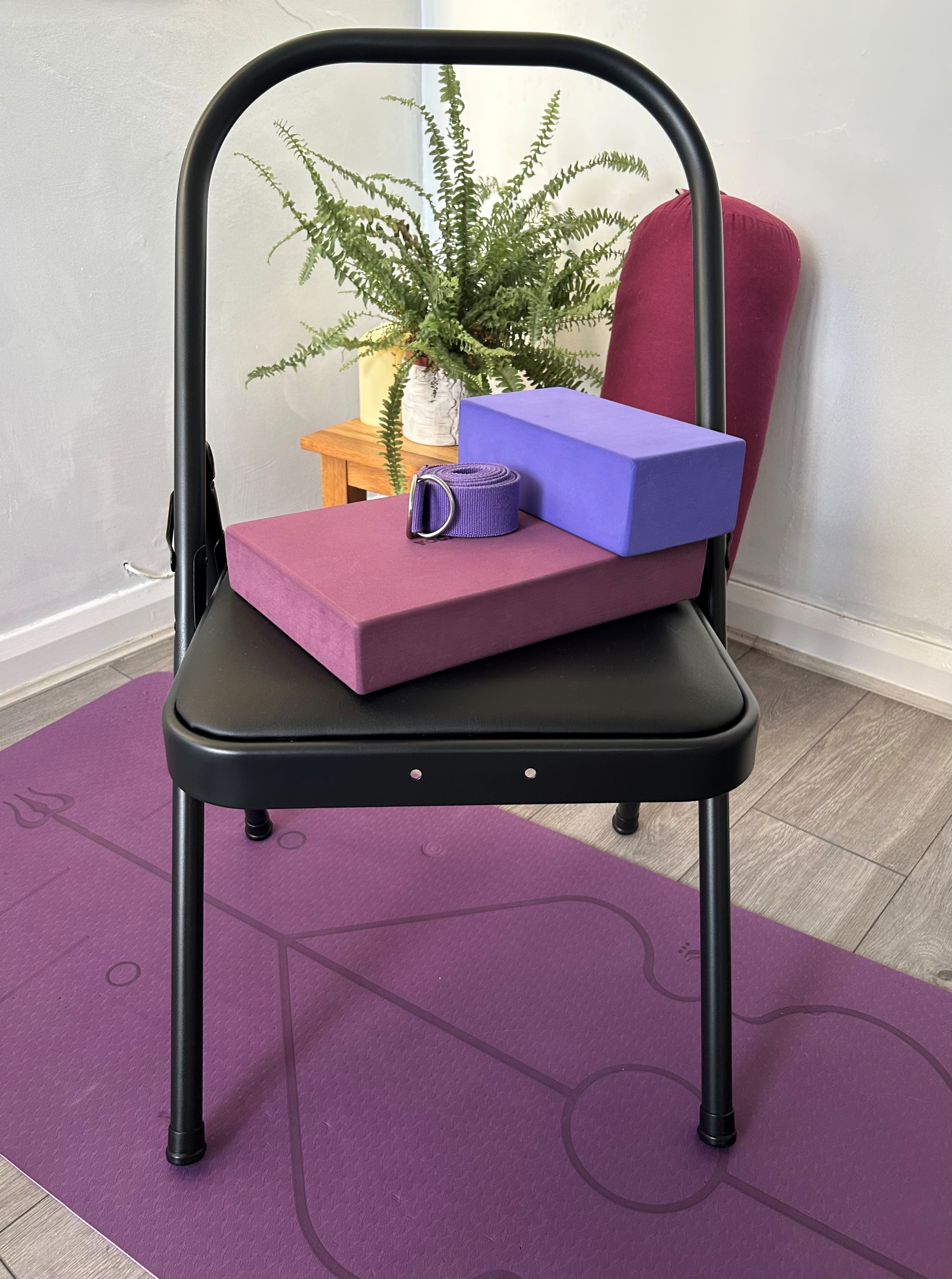
Whether I'm teaching Chair Yoga or other forms of gentle yoga, I'm not interested in pushing people towards a particular shape or asking everyone in the room to do the same thing. I offer options, encourage people to notice what feels appropriate for their body that day and make space for rest. Movement can be small or adapted and you can choose not to do something. Rest is always an option.
My own experience of ME/CFS means I also understand something that isn't always obvious from the outside: what looks gentle to somebody watching doesn't necessarily feel gentle to the person doing it. That's why I want the movement I offer through yoga to leave room for the person in front of me, rather than expecting their body to fit the movement.
So What Does Movement Look Like for You?
I’m not going to tell you what movement should look like for you because I don’t know your body, your baseline or your current capacity. Those things matter. The aim isn’t simply to exercise more. It’s to understand what your body can currently tolerate without repeatedly tipping beyond your energy envelope and triggering PEM.
That also means recognising when movement isn’t the priority. If you’re experiencing PEM, a flare-up or a relapse, your body may need you to reduce what you’re doing rather than look for movement you can tolerate. Sometimes less really is what your body is asking for. For me, this is about working from a reasonably steady baseline, not testing your limits when your body is already telling you it needs less.
For some people, movement might currently mean a few gentle seated stretches. For someone else it may look very different. There may also be times when your body needs very little movement at all beyond what is necessary for everyday life. That counts too.
If what you can manage now looks nothing like what you used to be able to do, that can be hard. I know something of that feeling myself. When movement has been part of who you are, adjusting to a body that suddenly has very different parameters isn't simply about changing how much exercise you do. There can be frustration, grief, fear and the constant temptation to compare yourself with the person you were before you became ill. You don't have to pretend those feelings aren't there in order to start listening to the body you have today.
Capacity can also change. What works on one day, or at one stage of illness, may not be right at another. That’s why I think noticing and responding to what your body is telling you matters far more than meeting somebody else’s idea of what “enough exercise” should look like.
It’s not about continually testing your capacity to find out how much you can get away with. Sometimes working with your energy means deliberately retaining some capacity rather than using everything that appears to be available. Movement, for me, leaves room for all of that.
It allows us to move away from the idea that doing more is automatically better and towards something much more individual: understanding the energy and capacity you actually have and working with your body rather than against it.
If You'd Like Some Support
There are different ways I can support you depending on what you're looking for. Through 1:1 coaching, we can explore your own patterns, energy and parameters and look at what is happening for you individually rather than applying a generic formula.
If you'd like to explore gentle movement in a supported environment, I also teach Chair Yoga in person and gentle, accessible yoga online, where the same principles run through my teaching: options, choice, noticing your own body and permission to rest.
If you'd prefer to begin exploring your patterns independently, my PDF trackers can help you start noticing what affects your energy, symptoms and capacity over time.
However you approach it, the starting point is the same: not what you think you should be able to do, but what your body is telling you today.
© Copyright Rebecca Jones 2026 All rights reserved
I'm a certified health & wellbeing coach and yoga teacher who lives with ME/CFS. I help people with chronic illness create compassionate routines and self-care that work with their energy, not against it.
The content in my blog posts is provided for your general information purposes only, that maybe of interest to you. Please remember it has not been created with your specific circumstances in mind and therefore should not be relied on as medical advice or any other type of advice.